
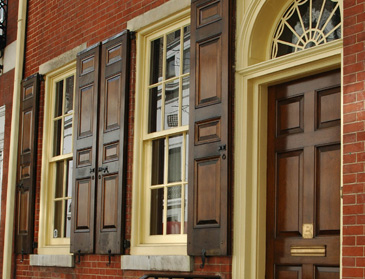
An old house keeps a surprisingly good record of its shutters, even when the shutters themselves went to the dump two owners ago. Pintles left in the window frames, a tie-back still screwed to the brick, scratches in the wall below a sill, a ghost of old paint where a hinge used to sit: each one is a clue to what hung there and when. Learn to read those clues and you can put back hardware that is right for the house instead of whatever happened to be on the shelf at the big box store.
We've been helping owners, architects and preservation groups work through these puzzles since our shop opened at the Bicentennial. Here's how we go about it, from the first walk around the house to the point where new hardware drops onto old pintles.
Start with whatever survived
The best case is finding one or more windows with original shutters and hardware still on the building, or stacked in the basement, the attic or the barn. That's your hardware. Shutters had a habit of getting a second career: when central heat came in, a lot of them ended up as coal-bin walls, and on our old farm they were nailed up in the barn to partition off pig sties and calf pens. Go look before you assume they're gone.
If you find even one original hinge, tie-back or lock, hang on to it. A sample always works best. We can match profile, weight of material, fastener pattern and offset far more reliably from a piece in hand than from a phone photo, and with something to copy we can make the missing pieces to suit.
The pintles tell most of the story
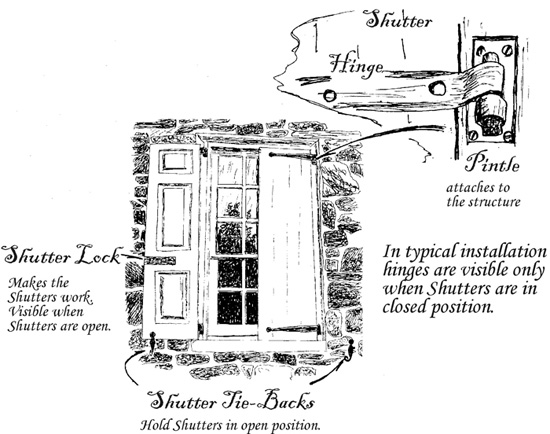
When the shutters are long gone, the pintles are often still there, and they tell most of what we need to know to define the right hinges. Pintles were built to stay put, and they usually did. Here is what to look for:
- A drive pintle or a plate pintle on the face of the frame means strap hinges were originally used.
- A mortised plate with a pin attached inside the window frame generally indicates a Parliament-style lift-off hinge.
- Female cups just beyond the joint between the window frame and the wall mean notched strap hinges with an integral pin. These are good news.
- A stub broken off flush with the frame often marks a cast pintle that someone knocked off with a hammer when the shutters came down.
All the dimensions you need are built into a surviving pintle. The height and diameter of the pin equal the hinge barrel dimensions. The distance from the face of the casing to the centerline of the pin is the standoff. The horizontal distance from the pin to the edge of the shutter defines the throw. And the height from the sill to a drive pintle is a good indication of how wide the original bottom shutter rails were. Our article on measuring for shutter hinges covers those terms in more detail.
The notched hinge and its female pintle
From about 1810, as houses began to be built with openings for prefabricated windows, a clever variation appeared. The pintle was a flat plate about two inches tall, notched to half its height and formed into a female barrel, then screwed to the side of the window before the window went into the wall. The matching strap hinge was notched the same way and carried its own pin. This arrangement was in wide use through most of the 19th century, and you can still see the female cups on window after window in older towns. They're made of steel, so they couldn't be snapped off, and the screws are in the side of the frame where nobody could get at them. Better still, they're almost all 1/2″ in diameter by 1″ high.
Clues on the face of the building
Step back from the windows and look at the wall. Shutter tie-backs are often still in place long after the shutters are gone, and they give you a good idea of the period of the rest of the hardware.
Our favorite clue is a set of inverted arcs scratched into the wall below the windows. Those lines were made by hooks that held the shutters open. When the shutters were closed, the hooks hung free, and years of wind swung their points back and forth across the face of the building, wood or masonry alike. The radius of the arc tells you the length of the hook, and its center points to where the hook was mounted on the sill.
Paint is evidence too. A shadow of older paint under where a hinge or tie-back sat shows its outline and fastener holes. And look at how things were fastened. Early hinges and locks were attached with rivets or nails driven through the shutter and clinched on the inside; cheap machine-made screws weren't readily available until about 1800, and lag screws not much before the late 1800s. The earliest tie-backs were riveted to a mount that was laid right into the masonry as the wall went up.
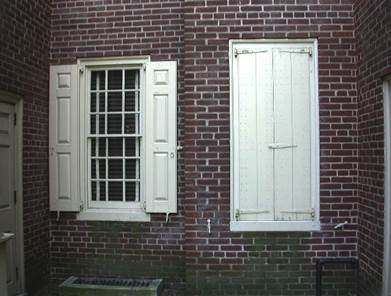
A short timeline of American shutter hardware
Hardware changed slowly until the Industrial Revolution and then quickly. Once you know the broad periods, most surviving pieces sort themselves out. This is the rough sequence we work from; our Hardware 101 pages tell the longer story.
| Period | Hinges and pintles | Locks | Hold-opens |
|---|---|---|---|
| Colonial, to about 1800 | Strap hinges on drive pintles driven into heavy timber window frames; mostly English-made | Forged strap lock with a pin and drop-in key | English "rattail" tie-backs; forged hooks in the country |
| Federal, about 1800–1830 | Strap hinges continue; plate pintles appear; short-lived cast butt hinges; notched hinge and female pintle from about 1810 | Slide-plate-and-keeper bolt appears | Cast iron tie-backs on sill arms, the "Federal Shell" dominant |
| Civil War era | Steel butt and H or Parliament lift-off hinges; strap hinges still common | Slide bolt still the standard | Hand-forged patterns giving way to industrial production |
| About 1870–1920s | Victorian cast novelties; "New York" style plate-steel hinges from about 1880 | Forged slide bolts | Stamped-then-hammered dogs; first commercial "S" tie-backs by Stanley; Colonial Revival patterns |
| 1920s to present | Mostly decorative installations after central heat arrived | Seldom needed on decorative shutters | Stamped "S" tie-backs, cookie-cut from the 1930s on |
Two cautions about that table. Inland, away from the ports where British authority was centered, local smiths made their own hardware, and you'll find German, French and Dutch patterns in pockets where those settlers grouped. And a house often carries more than one period: raised-panel shutters downstairs with louvered ones above usually means the upper shutters were added later.
Reading tie-backs and locks
Tie-backs are the most varied hardware on a shuttered house and the most visible on open shutters, so they're worth a careful look. Colonial-era dogs were mostly English and many were rattail variants. Cast iron dogs on arms extending from the sills became popular in the Federal period. Our shutter dogs and hold-opens are grouped by these same periods.
The familiar "S" is a trap for the unwary. Historically an S is a very difficult form to forge, and the first commercially produced ones came from Stanley Works in Connecticut around the 1880s. They weren't stamped until the 1930s. So the most common "old" tie-back really isn't old; it's just highly visible because so many were installed on 20th-century colonial-style houses.
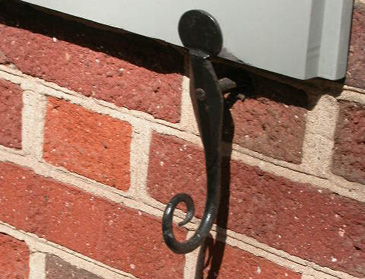
Locks date a house well too. Until about 1800, blacksmiths forged strap locks that matched the strap hinges: a plate riveted to one shutter with a pin about 1/2″ in diameter that passed through a hole in the other shutter, locked from inside by dropping a nail-like key through the pin. After 1800 the slide-plate bolt took over and became easily the most common historic shutter lock through the early 1900s. A forged rattail handle on a slide bolt is an earlier pattern than the more common "penny" handle and usually points to local blacksmith work. Matching locks are on our shutter locks and bolts page.
Restoring without destroying
Too often we've seen original windows nearly destroyed in the effort to remove old pintles. Our first rule of restoration is to keep what's sound and build new hardware to suit it. If you have surviving female cups, you only need matching notched hinges with an attached pin, and the shutters become a drop-in. Where the mortised plate of a Parliament hinge survives in the frame, our standard sizes are close to many originals and will mate with most; we provide the shutter halves so the existing hardware stays in place without removal or modification.
Many historic shutter locks have been painted or rusted shut, even though the hinges and dogs still work fine. Rather than chip away at an approved historic facade, a small storm latch mounted on the back of the shutters restores function. It lets you lock the shutters from outside, and when they're open it sits out of sight behind them.
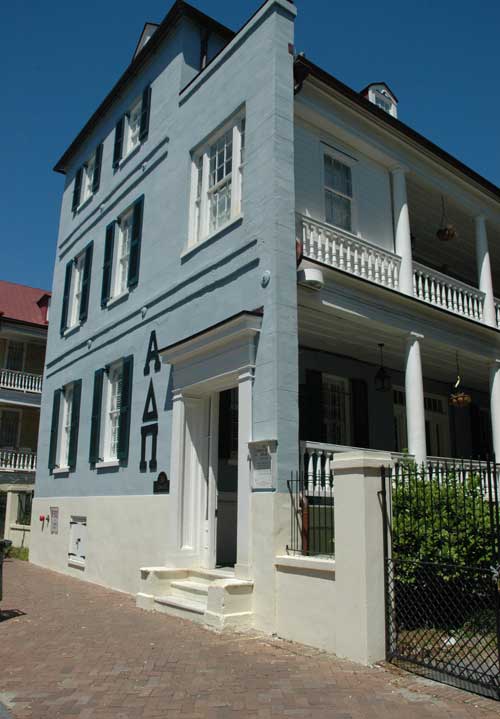
Our work on 36 Coming Street in Charleston, South Carolina, shows how this plays out. We helped identify the original hardware and detailed what was needed to restore the house to its original appearance. It was the earliest use of plate pintles we'd seen, and the reason was practical: the house had window weights, and a drive pintle hammered into the frame would have blocked the pocket the weights ran in. The original pintles were mostly intact, so we made only a few replacements and remade all the lost strap hinges. We also found evidence of a couple of unusual original shutter dogs on the upper floors, matched them, and fitted the whole house. The project received a 2016 Carolopolis Award from the Preservation Society of Charleston.
Finally, look around the neighborhood. Similar houses built by the same hands often kept what yours lost. Walk three or four blocks down the first street across the Schuylkill River bridge from our shop and you'll see about 150 years of shutter hardware evolution. Once you start looking, you'll notice functional shutters everywhere. More examples are in our projects.
Frequently asked questions
Can I reuse the original pintles on my house?
Very often, yes. Notched female pintles are almost all 1/2 inch in diameter by 1 inch high, which matches our standard notched hinges. Drive and plate pintles can usually be matched too, and leaving them in place spares the window frame.
How can I tell when my shutter dogs were made?
Start with the pattern and the mount. Rattail styles point to the colonial era, cast dogs on sill arms to the Federal period, and stamped S dogs mostly to the 20th century. A dog riveted to a mount set into the masonry is older than one held on with a lag screw.
What do curved scratch marks under my windows mean?
They were usually made by shutter hooks swinging in the wind while the shutters were closed. The radius of the arc tells you how long the hooks were, and the center of the arc shows where they were mounted on the sill.
Should I send a sample of my old hardware?
Yes, a sample always works best. With an original hinge, dog or lock in hand we can match its profile, material and dimensions far more accurately than from photos alone.
Bring your clues to the shop
Every old house is its own puzzle, and we enjoy working them out. Gather what you've found, whether that's photos of the pintles, a tie-back from the attic or measurements from a surviving hinge, and call us at 610-948-5116 or get in touch through our contact page.