
Barns and outbuildings were built as working structures, and the doors and their hardware are the hardest-working parts of them. A barn's long-term survival comes down to a couple of details: a dry roof, and heavy doors on heavy hardware. Look at any old Pennsylvania bank barn that's still standing straight after two centuries and you'll find both, along with a set of forged iron that was made by a local smith to suit that particular building.
We sort barn hardware into what we call the four H's: hinges, hasps, hooks and handles. There are no hard rules about which to use. Period, region, the job the door does, the owner's taste and the skill of the local smith all shaped the originals, and they still shape ours. What follows is how each piece works, what to look for, and how to get it on the door so it stays there.
First, know your doors
Barns have lots of doors in different sizes, shapes and jobs, and the hardware follows the door. Almost all early barn doors were hung on heavy forged strap hinges and sturdy pintles fastened into the structure. They fall into a few loose groups:
- Great doors are the biggest doors on the barn, opening onto the threshing floor. They were sized so a team could pull a loaded wagon right in. Many were later replaced with lighter doors on rollers and tracks, but the massive pintles often remain in the hewn beams.
- Dutch doors were the most common on early barns, especially the row of stall doors along the south side to catch the winter sun. The split door lets in light and air while keeping livestock inside. Two pairs of heavy strap hinges and pintles, plus latches or bolts, make them work.
- Passage doors are simple board-and-batten doors for people, on the outside of the barn, on tack rooms, at the tops of stairs and on most outbuildings.
- Specialty doors include feed bins, tack boxes and the "parlor door," places where small, nicely made hardware gets noticed.
A passage door was often cut right into a great door so the farmer could get onto the threshing floor without swinging the big doors. A "threshold" passage door leaves a board across the bottom and hangs on its own smaller strap hinges and pintles. A full-height passage door is easier to roll a cart through, but the bottom strap of the big door has to stop short or have a second hinge joint built into it. That's a detail to settle before the door is built, not after.
Hinges: the strap does the showing, the pintle does the work
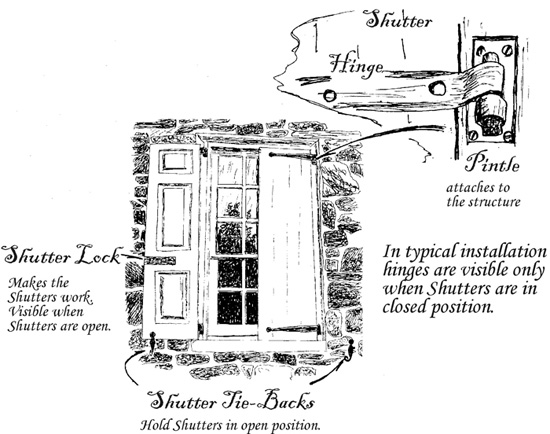
The typical barn hinge is an iron strap that fastens to the door. The pintle, the pin it hangs and swings on, fastens to the structure. Strap hinges are on display whenever the doors are closed, so they're a big part of how the barn looks. But all of the weight of the door is carried by the pintles, so their secure attachment is what matters most. We sell hinges and pintles as separate pieces so you can pick the pintle that installs best and then the hinge you like the look of.
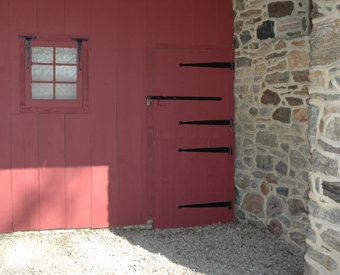
Long after lighter manufactured hinges were in every store, farmers kept using heavy, locally made straps on barn doors. Livestock gives doors a pounding, and a failed hinge can turn the animals loose and send the farmer on a bothersome roundup. Forged steel bends before it breaks, which is a big part of why we never cast barn hardware; our article on hand forged, drop forged and cast iron explains the difference. Strap hinges are generally 1/2 to 2/3 the width of the door, though historic examples show almost any length will work. On Dutch doors you can play with the proportions: longer hinges on the bottom door to visually carry it, or two lengths staggered with the shorter ones in the middle to leave room for a latch.
Two weights of hardware
We make strap hinges in two weights. Our heavy-duty line is what we hang shutters, gates and smaller doors with. Our barn-weight line steps up to 1/4-inch material, which matches most early barn hinges and stands up to big doors and rough livestock duty.
| Feature | Heavy-duty (700 series) | Barn weight (750 series) |
|---|---|---|
| Material thickness | 3/16 inch domestic steel | 1/4 inch steel |
| Strap widths | 1-1/2 and 2 inches | 2, 2-1/2 and 3 inches |
| Barrel / pintle pin | 1/2 inch diameter | 1/2, 5/8 or 3/4 inch, scaled to width |
| Mating pintles | 300 series | 320 series |
| Fasteners supplied | 1/4-inch lag screws | 5/16-inch lags (2 and 2-1/2 inch); 3/8-inch lags (3 inch) |
| Typical use | Shutters, gates, doors up to about 75 lbs per pair | Great doors, Dutch stall doors, heavy gates; standard lengths up to 72 inches |
Profiles run from the plain storm strap to the tapered strap, the hammered-bevel strap typical of the 1700s and our own Westport. Tapered and beveled barn straps can be finished with a penny, heart or bean end. The whole line is on our barn, gate and heavy door hardware page.
Start with the pintle
Before you think about hinge style, think about where and how the pintles will mount. The most common barn pintles today are the lag screw pintle, which looks much like an early drive pintle once installed and works well in most situations, and the jamb leaf pintle for contemporary framed openings. For heavy timber framing we forge drive pintles. For stone or concrete we offer embedded masonry and female pintles. Big early great doors usually hung on heavy through-bolt pintles with a threaded shaft, forged to fit both the hinge and the beam. Surface-mounted pintles, including the serpentine pattern seen at Hopewell, hang a passage door within a great door or a door in a board wall. The pintle choice is the same thinking we lay out in our installation guide.
Hasps: the barn's everyday lock
Hasps were the most common way to secure a barn, corn crib, woodshed or similar outbuilding. Barn door bolts are popular too, but the hasp is purely functional and a unique fixture of the American barn. Some hasps are fixed solid to the door; others swivel and hang down out of the way when not in use. Each was made in a local shop, so sizes and shapes vary widely.
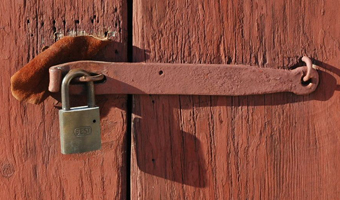
The hasp drops over a heavy staple driven into the jamb or embedded in the masonry. Padlocks were expensive, and most barns were secured to keep livestock in and raccoons out, so we believe that more often than not a corn cob or wooden peg went through the staple. On a Dutch door where the top half overlaps the bottom, a single hasp on the top door can lock both. Old smiths got clever with hasps, too. At Landis Valley there's a mid-1800s Dutch door where the bottom strap hinge was simply extended to double as the locking hasp. On a woodshed at the Peter Wentz farmstead, a long strap hasp with a staple on each side locks the door either open or closed.
Hooks: simple, strong and easy to read
Hooks were easy for a local smith to make and turn up everywhere on early buildings, in sizes to suit the door. It's common to find hooks set up to hold a door in both the open and the closed position. On a Dutch stall door, a forged hook inside often locks the bottom half, and a hook above the latch on the outside locks the top door, which in turn secures the bottom.
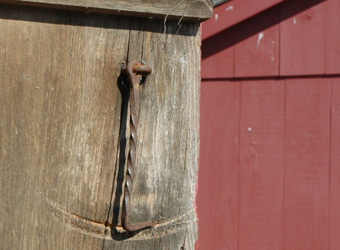
Hooks also leave evidence behind. A hook that hangs loose swings in the wind for years, and its point scribes an arc into the wood or stone below. Find that tell-tale arc and you know a hook was once there, how long it was, and where it was fastened. That's useful when you're putting an old building back the way it was.
Handles and latches
Plain or fancy, large or small, early barns carry endless examples of hand-forged handles. Some are simple pulls. Others actually latch the door closed. Some of the finest early American door pulls are found on the barn's "parlor door," the formal entry, usually sheltered by a pent roof, where the farmer came from the house into the ground-floor milking parlor every morning and evening.
Latches on barns were often the same patterns used on houses of the period. On the Wentz barn's Dutch stall doors, an 18th-century lift latch with a delicate rattail lift handle and a braced rattail catch secures the bottom door. A thumb latch, like the ones inside the house, lifts the outside latch bar from inside the door. And a homemade wooden turn-buckle holds the top and bottom halves together so the Dutch door can swing as one.
Installing barn hinges so they stay put
Whether it's a big door, a small door or a shutter, the steps are the same. The key is getting the door into the right position in the opening and holding it there while you hang the hardware. The other key is fasteners. The hardware carries the weight of the door, but the fasteners carry the stress of transferring that weight to the building, and nearly all of it lands on the pintle fasteners and the first fastener in each strap.
- Shim the door into position with ordinary door-frame shims, using 2x4 blocking first under heavier doors. Check that it's plumb.
- Set the hinge so the barrel falls right on the seam between the door and the jamb, and mark it level.
- Pre-drill and drive the first fastener at the end of the strap, check level, then drive a second.
- Slide the pintle onto the hinge, eyeball it horizontal, and install just two fasteners in it.
- Measure off the first hinge to locate the second, repeat, then pull the shims.
- Check that the door stays level and swings properly, then install the rest of the fasteners.
Using only two fasteners per piece at first means that if something needs adjusting, there's fresh wood under the unused holes. Lag screws up to about 2 inches long are no worry. Beyond that, be careful: most fasteners are made offshore from weak material, and you can twist the head off a 3-inch lag quite easily. For long screws or tough wood like oak, drill a full-size 3/16-inch pilot hole nearly the length of the screw, and rub a little bar soap on the threads.
Snug is tight enough. Over-tightening a lag screw scrubs the finish off the hinge around the hole, and that's exactly where rust starts. Our standard finish is e-coat; straps over 48 inches that are too long for the e-coat line get a heavy powder coat in an exact match, and bare metal is available if you plan your own finish. See our standards and finishes page for the details.
Frequently asked questions
How long should barn door strap hinges be?
The traditional rule of thumb is 1/2 to 2/3 the width of the door. Historic barns show that almost any length will work, so it is largely a visual decision. Larger doors look right with larger hinges.
Can I mix hinge styles and pintles?
Yes. Any of our hinge styles can be paired with any pintle of the matching size, which is why we sell them separately. Choose the pintle that installs best in your structure first, then pick the hinge you like.
How many hinges does a barn door need?
Most doors hang on two strap hinges, and a Dutch door needs two pairs, one pair for each half. Even very large doors can hang on two hinges because the pintles anchored to the structure carry the weight. Very heavy doors may call for heavier barn-weight hardware or custom pintles rather than more hinges.
Do I need a padlock on a hasp?
Only if you need real security. Historically a wooden peg or even a corn cob in the staple kept livestock in and raccoons out. A padlock goes through the same staple when you want one.
Talk it through with the shop
Every barn is different, and the best hardware set comes from talking through your doors, your framing and how you use the building. We can match or repair original hardware or help you design your own. Browse our gallery for ideas, then call the blacksmith at 610-948-5116 or use our contact page.