
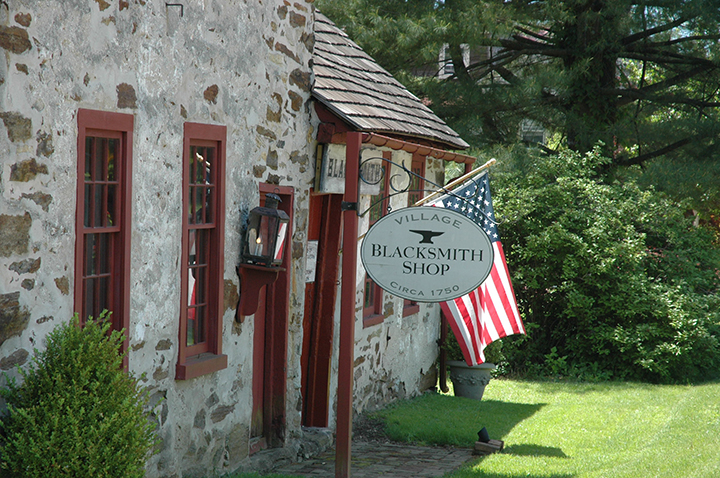
Walk the hardware aisle of any big box store and you'll find hinges labeled "wrought iron," hooks labeled "hand forged" and a lot of black metal that looks old from ten feet away. Pick it up and the story changes: some is cast, some is stamped from thin sheet, and almost none of it is what the label says. We've been heating and hammering iron and steel in our shop since the 1976 Bicentennial, and we think anyone buying hardware that will hang on their house or barn for the next century deserves to know what the words actually mean.
This is a plain-spoken tour of the materials and the methods: iron, cast iron, wrought iron, steel and stainless, and the three ways they get shaped into hardware. Along the way we'll explain why cast hinges crack and what "hand forged" means when a blacksmith says it rather than a marketing department.
Start with the metal: iron, cast iron and wrought iron
Iron is one of the most common elements on earth by weight and, at the same time, one of the rarest in its pure form. The red hills of the Rockies and the brown and gold fieldstone of a Pennsylvania farmhouse wall are full of it, but only as iron oxides. About the only pure iron in nature arrives in fresh meteorites, and even those rust soon enough.
Cast iron is what you get when you first pull iron out of the ore. Iron-rich ore is heated to a molten state along with limestone; the oxygen moves over to the calcium and forms a slag that floats on top of an increasingly iron-rich pool. Open the bottom of the vessel and the iron pours out, historically into sand patterns for stoves and such, or into troughs on the foundry floor to make rough billets. Cast iron flows easily into molds and makes intricate shapes quickly. The bad news is that it's brittle. Impurities are never fully leached out, carbon from the fuel gets absorbed into the melt, and it cracks rather than bends.
Wrought iron literally means "worked," or hammered, iron. Those cast billets went to an iron forge, were heated to near-molten and pounded flat under a water-powered drop hammer: a heavy wooden beam with a couple of hundred pounds of iron on one end, lifted and dropped by a cam turning with the water wheel. Valley Forge, a few miles down the Schuylkill from our shop, took its name from just such an operation. The smith hammered the billet long and thin, folded it back on itself, reheated it and hammered again. Every heat and every blow burned and drove out impurities, and the iron got more malleable each time. The finest forging iron was multi-layered and nearly pure.
As far as we know, nobody is making new wrought iron today. If it's on a store shelf and the label says "wrought iron," it isn't.
Steel, stainless and why the blacksmith cares
Steel is basically iron with a closely controlled amount of carbon, sometimes with other metals added. Add chromium and you get stainless. The Bessemer converter, invented before the Civil War, is why wrought iron disappeared: air blown through molten iron burns out the impurities, then the right additives go back in. Steel became cheap and plentiful, and hardware makers jumped on it.
The big practical difference is that steel can be hardened and iron can't. Heat steel red-hot and quench it, and it gets hard. Heat iron red-hot and quench it, and it gets cold. Fully hardened steel is also brittle, which is why a file will cut mild steel all day but snaps in half if you clamp it in a vise and whack it. Tempering is controlled reheating that relaxes hardened steel to the right balance of hardness and toughness, and smiths have always judged it by the colors clean steel turns as it heats, from pale straw toward purple and blue. Spring steel is often that bluish-purple: soft enough to bend, hard enough to spring back.
For hardware that hangs doors and shutters we don't want hard and springy. We want tough and forgiving. Our standard strap hinges are 3/16-inch-thick mild steel, and our barn-weight straps are 1/4-inch, which matches the weight of most early barn hinges. For salt air and hurricane country we make the same patterns in domestically produced 304 grade stainless. You can see the full lineup on our heavy strap hinges and pintles page.
Three ways to shape it: cast, drop forged and hand forged
There are really only a few ways to get metal into the shape of a hinge, a hook or a latch, and each leaves its own fingerprints.
- Cast: molten iron poured into a mold. Lots of detail, little labor, and brittle.
- Drop forged: red-hot iron or steel placed in a die impression and struck by a matching die on a heavy ram, often through several impressions. Adjustable wrenches are drop forged: detail like a casting, without the brittleness.
- Hand forged: iron or steel heated and hammered to shape on an anvil without closed dies. The smith decides how the material moves with every blow, so each piece comes out slightly different.
A fourth method, stamping or "cookie-cutting" shapes from plate with heavy presses, came of age after the Civil War. Much hardware from 1870 on was stamped and then hand-hammered to finished form.
| Method | What shapes the piece | Strength | Weakness | Where you see it |
|---|---|---|---|---|
| Cast iron | A sand or metal mold | Intricate detail, quick to produce | Brittle; cracks rather than bends, especially in thin pieces | Victorian hardware, Federal shell tiebacks, stoves |
| Drop forged | Closed dies on a heavy ram | Crisp detail and good toughness | Needs costly dies; every piece identical | Wrenches, heavy gears, cam shafts |
| Stamped | Presses cutting plate or sheet | Fast and cheap in volume | Often thin stock; no shaping beyond the outline | "S" tiebacks from the 1930s on, "New York" style hardware |
| Hand forged | The smith, a hammer and an anvil | Tough, ductile, can be shaped to fit | Labor-intensive; small variations from piece to piece | Colonial and barn hardware, our beveled straps and hooks |
Why cast iron hardware breaks
We'll say it the way we've said it in our gallery for years: cast iron shutter hardware breaks. The impurities and absorbed carbon that make cast iron flow so nicely into a mold also make it brittle, and how fast a casting cools matters too. Big heavy castings like machine frames hold their heat and cool slowly. Small, thin castings like hinges cool fast and come out more brittle still.
History bears it out. When machine-made screws became cheap around 1800, cast butt-type shutter hinges showed up in the Federal period and quickly fell from favor, most likely because they broke. Victorian cast hardware was neat stuff, but subject to breakage, and it didn't last much past the turn of the century. When shutters came down, cast pintles were often knocked off flush with a hammer, while steel pintles from the same era are still on many houses because nobody could break them off.
The way hardware fails in real life is rarely a straight overload. Hinges and pintles rust together, then along comes the painter who yanks the shutter open. Forged mild steel bends under that leverage and can usually be straightened. Cast iron just snaps. That's why everything we make for hanging and swinging is forged or fabricated from steel bar and plate, and why we keep generous clearance between our hinge barrels and pintle pins, which we cover on our standards and finishes page.
Hand forged at the anvil: what it actually means
In drop forging, once the operator moves the piece from one die cavity to the next, there's no human input to the shape. The dies do it. Hand forging is the opposite. The hot bar sits on the anvil and the smith decides, blow by blow, where the metal goes. That's why no two hand-forged pieces are exactly alike and why we can't give you a hard tolerance on a beveled hinge or a forged tieback. They'll be close enough to tell they were made by the same hands at the same time, and that's what hand made means. On plain strap hinges we can generally hold the length to within 1/2 inch.
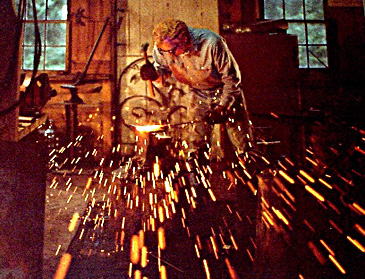
Our shop is not a museum. We fire propane forges because their steady heat lets us keep more irons in the fire, and we work pieces off the end of a bar for better control than tongs give. The old smiths weren't artists; they made functional, affordable goods and improved production whenever they could. We've adopted those improvements and added historic and modern machinery where it makes sense. That makes us production blacksmiths: we make it right and we make it fast. You can read more about that on our about page.
If you find "hand forged" printed on plastic blister packaging with a barcode, be suspicious. Real hand forging shows small variations from piece to piece, honest hammer texture, and a thickness that changes where the smith drew the metal out. A row of perfectly identical "hand forged" hooks was made by a die, not a hand.
How hardware got made, from colonial forge to factory press
All of the hardware in colonial America was hand forged, and most of it in England. Colonists were forbidden to manufacture goods, so America shipped iron and charcoal across the Atlantic and bought it back as hinges and latches. Inland, local smiths quietly broke the rules. Here's the rough timeline, as we read it from the hardware itself:
- Before about 1750: ornate, chiseled and filed hardware, following the pattern set by castle and manor work in Europe.
- Around 1750: English "factories" (really just dozens or hundreds of smiths hammering under one roof) discovered that cheaper outsold better. H and HL hinges lost their decorative filing but kept their function.
- Around 1800: machines for making screws and rolling thin iron sheet arrived. The slide-plate shutter bolt appeared and has been made ever since, and cast hardware could finally be screwed on economically.
- Civil War era: Bessemer steel, heavy presses and rail transport. Steel butt and "Parliament" lift-off hinges, and much hardware stamped and then hand-hammered.
- About 1880 onward: "New York" style plate steel hardware assembled in big factories, and the first commercial "S" tiebacks from Stanley Works. They were forged at first and weren't stamped until the 1930s.
That last point surprises people: the most familiar "old" tieback in America isn't very old at all. It's just everywhere. For more on reading these clues on your own house, see our article on identifying historic shutter hardware.
How to tell what you're holding
To a blacksmith, every original piece tells the story of how it was made: the material, the varying thickness, the hammer marks the old smith left behind. You can read some of those signs yourself.
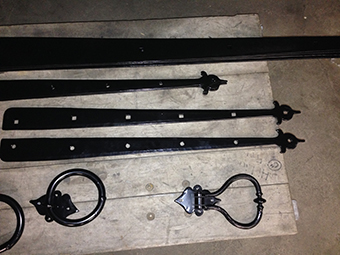
- Look at the thickness. Forged pieces swell and taper where the smith drew them out. Stamped pieces are the same thickness everywhere, often thin.
- Look at the surface. Castings tend to show a grainy, sand-mold texture and sometimes a seam where the mold halves met. Forgings show hammer facets and bevels.
- Look at how it failed. Bent hardware is forged or wrought. Cracked or snapped-off hardware is very often cast.
- Look at the fasteners. Rivets and clinched nails generally predate cheap manufactured screws, which arrived around 1800.
- Ask about thickness. Skimping on material is how a lot of imported hardware gets so cheap.
Frequently asked questions
Is wrought iron still made today?
As far as we know, no new wrought iron is being produced. Modern "wrought iron" railings and hardware are almost always mild steel, and plenty of it is cast or stamped. Steel replaced wrought iron once the Bessemer process made it cheap.
Is drop forged hardware as good as hand forged?
Drop forging produces tough, detailed parts and is excellent for tools like wrenches. The difference is that closed dies make every piece identical and the dies are costly, so it suits high-volume parts. Hand forging lets a smith fit a piece to a particular door, gate or original pattern.
Why not just use cast iron hinges if they look right?
Cast iron is brittle and cracks rather than bends, and small thin castings like hinges are the most brittle of all. Hardware that swings and takes leverage is exactly where that matters. Cast pieces have a long history of breaking on shutters and doors.
What steel do you use?
Our standard heavy strap hinges are 3/16-inch domestic mild steel, and our barn-weight straps are 1/4-inch. For coastal and hurricane-prone homes we make the same designs in domestically produced 304 grade stainless. We've never seen a shutter hinge of our heavy weight fail.
Talk it through with the shop
Whether you're matching an old cast piece that finally broke, replacing big box "wrought iron" that bent on the first windy day, or starting fresh, we're happy to help you work out what will last. Call the blacksmith at 610-948-5116 or reach us through our contact page.