Hinges & Pintles
Heavy Strap Hinges & Pintles
The heart of every functional shutter installation.
Quoted to size
Details

Stock & custom · quoted to size
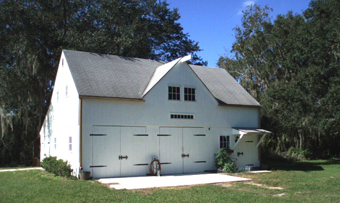
Barns and outbuildings are working structures, and the doors and hardware are the “workingest” part. Heavy use dictated heavy hardware to swing heavy doors — our barn line is based on historic American blacksmith-made hardware that has functioned properly for two centuries and more. Gates are really just doors in fences or walls, so the same hinges and pintles scale up to fit.
Reference prices from our price sheet; prices change with steel costs, so we confirm current pricing, finish and lead time with you before anything is forged. See ordering information.
A barn’s long-term survival comes down to a couple of details: a dry roof, and heavy doors and hardware. There are no hard rules for which hardware to use — period, region, intended use, personal taste and the skill of the local smith all drove the finished product. Browse your neighborhood and our gallery for ideas; we can match or repair your original hardware or create your own originals.
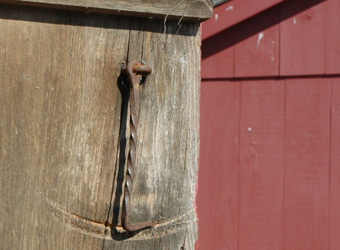
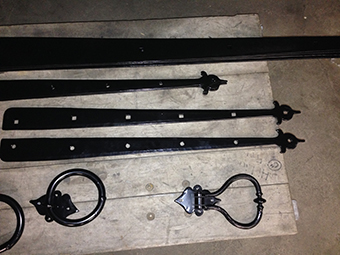
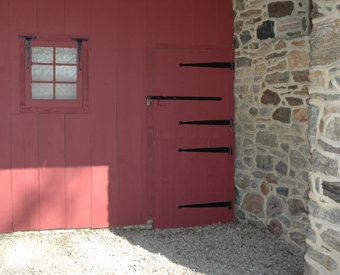
The typical barn hinge is an iron strap attached to the door; the pintle it swings on is attached to the structure. Long after lighter manufactured hardware was in the stores, heavy locally-made strap hinges stayed on barn doors — livestock gave the doors a pounding, and a failed hinge meant a bothersome roundup. Strap hinges are generally ½ to ⅔ the width of the door they swing.
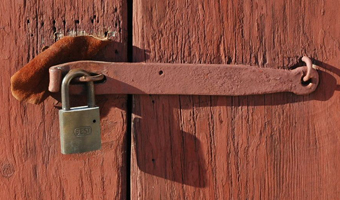
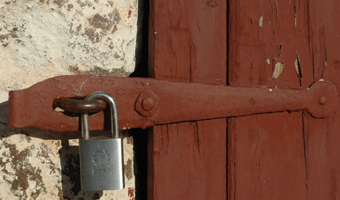
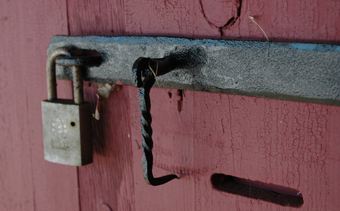
Hasps were the most common way to secure the doors of a barn, corn crib or wood shed — some fixed firmly to the door, others free to swing down out of the way. Padlocks were expensive, so more often than not a corn cob or wood peg was shoved through the staple.
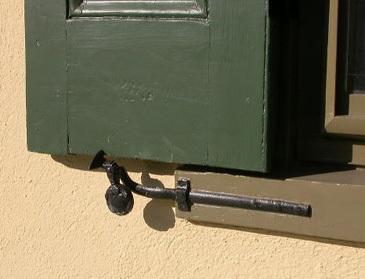
Easily fashioned by the local smith and common on early buildings, hooks were sized to the door and often made to hold doors both open and closed. Look for the tell-tale arc scribed into the wood or stone below a hook — it tells you the hook length and where it was attached.
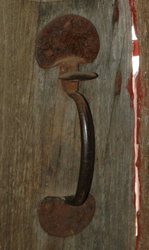
Plain or fancy, handles served as pulls or actually latched the door. Some of the finest early American door pulls are found on the barn’s “parlor door” — the formal entry, usually under a pent roof, where the farmer came in daily to the milking parlor.
Large or small, gates hang the same way doors do: hinges on the gate, pintles on the post or wall. Our gate hinges and pintles are the same strap hinges and pintles we make for doors and shutters, scaled up to the project. Board gates in board fences take surface-mounted pintles; heavy gates may hang on threaded pintles drilled through a 6×6 post and secured with nuts; poured concrete posts and masonry columns need pintles designed for those materials. Arched hinges are custom pieces, and we only make them from a full-size template.
Our biggest work hangs and locks 12-foot doors at the Royal Caribbean cruise terminal in Historic Falmouth, Jamaica — heavy straps, masonry pintle anchor plates buried behind the façade, and hurricane head, foot and horizontal bolts scaled up from an 18th-century Philadelphia original. Each of our own shop doors hangs on just two strap hinges: it’s the pintles anchored into the walls that carry the weight. See the full story on our projects page.
As a rule of thumb, barn door strap hinges run from one half to two thirds of the width of the door they swing.
Yes. We can match or repair original hardware, or design something new in the spirit of local early work. A sample or good photos with dimensions is the best starting point.
Yes, as custom pieces. Price depends on the size, style and arch radius, and we make curved hinges only from a full-size template so they fit exactly.
The heart of every functional shutter installation.
It’s quite simple … if shutters don’t lock in the closed position, they don’t function.
Whether you need hurricane hardware for an oceanside property or just want a forever-maintenance-free exterior, stainless steel is the unsurpassed option.
We’re happy to help you configure a hardware and shutter solution that will install easily, function properly, and can save you time and money.