
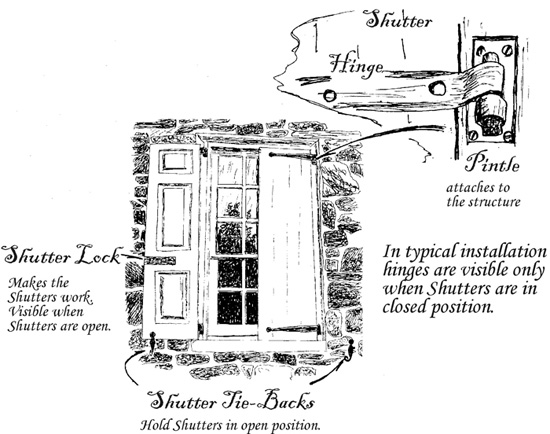
A functional shutter is a simple machine, and like any simple machine it only works when all of its parts are present. Somewhere in the last hundred years most of America forgot that, and shutters turned into painted boards screwed to the siding. We are blacksmiths who have spent decades putting the working parts back, and the questions we hear most often come down to a handful of pieces of iron: what they are called, what they do, and which ones you actually need.
This guide walks through the hardware that makes a shutter swing, stay open and lock shut. It covers hinges and pintles, shutter dogs and hooks, and the locks nobody remembers until the first storm. Learn these few terms and you will be able to talk to a shutter maker, a contractor or our shop without feeling like everyone else got the glossary but you.
Three jobs every functional shutter has to do
Functional wood shutters were expensive but necessary appointments on early homes. Ground-floor shutters provided security, all of them served as a first barrier against winter wind and summer sun when a wood fire was the only climate control, and in crowded colonial cities closed shutters gave privacy from the folks on the stoop. Regardless of the period, size or style of the shutter, the hardware has three jobs to do:
- Hold the shutter open, parallel to the face of the house, so it does not flap and bang in the wind. That is the work of shutter dogs, hooks and stays.
- Swing the shutter closed so it covers the window and sits parallel to it. That is the work of hinges and pintles.
- Lock the shutter shut against storm wind and uninvited guests. That is the work of shutter locks, bolts and latches.
Leave any one of the three out and you do not have a functional shutter; you have a decoration with ambitions.
| Hardware element | Mounts to | Job | Seen when shutter is open? |
|---|---|---|---|
| Hinge | The shutter | Carries the shutter and swings on the pintle pin | Usually not; it sits behind the open shutter |
| Pintle | The casing or the structure | Provides the pin (or socket) the hinge pivots on | Partly; you see the pin and a bit of hinge barrel |
| Shutter dog, hook or stay | The wall, sill or shutter | Holds the shutter open against the house | Yes, front and center |
| Lock, bolt or latch | The face or back of the shutters | Holds the closed pair together | Yes; the most visible piece of all |
Hinges and pintles: the working end
Shutters attach to the building with hinges and pintles working as a team. The hinge fastens to the shutter. The pintle fastens to the house and provides the pin the hinge swings on.
Strap hinges
Strap hinges are the oldest and most common shutter and door hinges, in continuous use since Roman times because they work and last just about forever. They were generally sized to span one half to two thirds of the width of the shutter, and because they mount across the face, they tie the boards or the frame of the shutter together. Our heavy strap hinges and pintles are made from 3/16″ thick steel, simply because we have never seen a shutter hinge in that weight of material fail. They come narrow (1-1/2″ wide) or wide (2″ wide), and the item number tells the story: a 705-N-12-1 is a 705 storm strap, narrow, 12″ long, with a 1″ standoff.
Pintles
Picking a hinge is mostly a matter of taste. Picking the pintle is where the real decision lies, because the pintle has to fasten securely to whatever material and mounting surface your house actually offers. We make drive pintles for timber framing, plate pintles (probably the most common early form), narrow plates for skinny casings, jamb pintles that mortise into the frame, lag pintles, and female pintles for hinges with built-in pins. All of our heavy pintles carry 1/2″ diameter pins mated to the heavy hinges, with standard standoffs of 1″, 1-1/2″, 2″ and 3″. We have seen far too many fine moldings butchered to accept cheap hardware; the right pintle prevents that.
Lift-off by design
Every true shutter hinge is a lift-off hinge. The pintle pin points up, the hinge barrel drops over it, and the shutter with its hinges lifts free for painting on sawhorses at ground level. That is why old houses so often show white pintles and dark green hinges: the pintles stayed on the window and got painted with the trim, while the hinges went down with the shutters. One practical warning follows. Avoid standard multi-joint butt hinges on exterior shutters; they rarely function well and become a nuisance over time.
Notched hinges and edge-mounted hinges
From about 1820 to 1900, many strap hinges were made with a notched barrel and an integral pin that dropped into a female pintle screwed to the window frame. Whole neighborhoods still have those pintles in place long after the shutters left; if yours do, a set of notched hinges makes the job nearly a drop-in. Edge-mounted hinges such as parliament hinges came later and mortise into the frame and the shutter edge. They work, but without a strap bearing the weight across the shutter it is up to the wood alone to resist gravity, and many such shutters have sagged out of square. Our lighter alternatives are the midweight shutter hinges, made from 1/8″ material and sold left- and right-handed.
Hold-opens: shutter dogs, hooks and stays
Hold-opens keep an open shutter snug against the house, which protects a valuable wooden shutter from slamming itself to pieces in a gale. They come in two general forms.
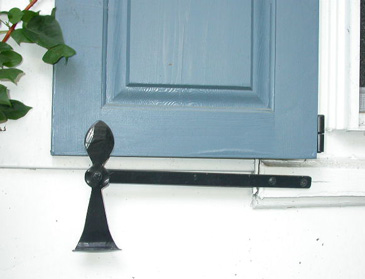
Shutter dogs (tie-backs)
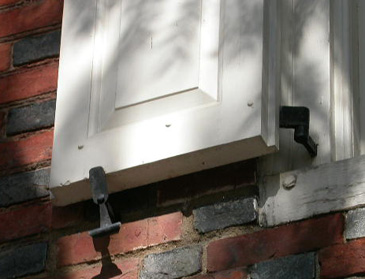
Shutter dogs fasten to the wall below the shutter and overlap its bottom rail. Rotate the dog 90 degrees and it clears the shutter, which can then swing closed. Most mount at the bottom of the window, one half to two thirds of the way across the shutter. The critical dimension is height: the dog must sit high enough to engage the open shutter firmly, but low enough that the shutter clears it when the dog is turned horizontal. Side-mount or offset dogs fasten at the outside edge of the shutter instead. They were common on door shutters that come down close to a porch deck and on second-floor shutters with a pent roof right underneath, and they anchor the shutter at mid-height, which reduces leverage on the fastener.
Pre-Civil War dogs were hand forged at the anvil. Between the 1870s and 1920s, most were stamped by heavy presses and finished by hand, and the Stanley Hardware Works produced the first S-shaped tie-backs. After central heat arrived, the S became dominant because it could be cookie-cut on automated presses. You can browse the whole range on our shutter dogs and hold-opens page.
Hooks and stays
Heavy forged hooks were a simple and effective way to hold shutters open, and they are common on early farmhouses here in southeastern Pennsylvania. We forge ours from 3/8″ round stock. The shop definition is plain: if the eye is fastened to the sill, it is a hook; if the eye is fastened to the shutter, it is a stay. We like the stay, because the body of the hook makes a handy handle for pulling the shutter closed. Hooks do need a fairly substantial sill to anchor them.
Locks: the part everybody forgets
It is quite simple. If a shutter does not lock in the closed position, it does not function. Every historic shutter was built and installed to function, and the old folks closed and locked theirs through the winter, on most summer nights, and any time weather or drunks were on the horizon. They drank a lot back in the day.
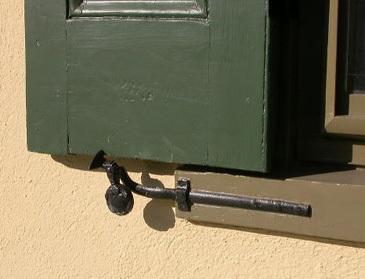
Shutter locks have evolved along with everything else:
- Colonial strap locks were forged until about 1800 and usually matched the strap hinges. A pin passes through the closed shutters and a "key" drops into a slot in the pin from inside.
- Forged slide bolts were made from the early 1800s into the early 1900s and are easily the most common historic shutter lock across the country. Our 610 matches early work; the 615 is a scaled-up version for bigger shutters.
- Barrel bolts such as our 620 use a heavy 5/8″ diameter forged barrel for a bold, unmistakably "secured" look.
- Storm latches solve the louvered-shutter problem. Raised-panel shutters usually have a lock rail near mid-height; louvered shutters often do not, leaving only the narrow outer stiles, which are too narrow for a typical slide bolt.
Even if you never plan to close your shutters, put locks on them. Hinges hide behind an open shutter, but the lock sits right on its face in a strong horizontal line, and it is the most visible piece of hardware from the street. Mount it at a height you can easily reach through an open window, and the day a storm is coming you will be glad you did.
See our shutter locks and bolts for the full range, from colonial patterns to pieces of our own design.
How the hardware fits your house
The rules for a functional shutter are short. It must lie parallel to the window when closed and nearly parallel to the face of the building when open. How you meet those rules depends on two facts about your house.
First, is the window flush with the face of the wall, as on most frame houses, or recessed in an opening, as on most stone, brick and stucco buildings? A flush window is straightforward; the shutter opens and closes like a door. A recessed window means the shutter must travel outward to clear the depth of the opening before it can lie flat against the wall. That distance is the offset, and it has to be built into the hinges and pintles. Second, will the shutter close inset, inside the window frame, or proud, resting on the outside of the casing? And will the pintles mount to the casing or directly to the masonry?
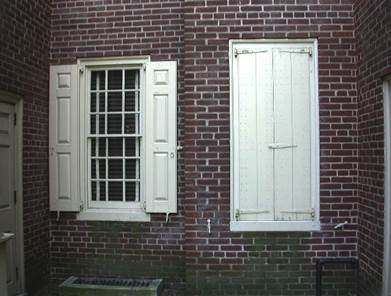
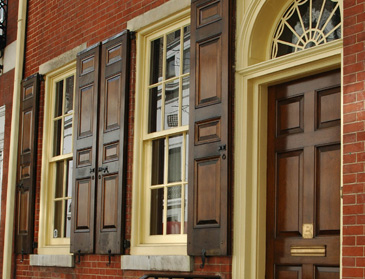
Note in the photo that the hinges show only on the closed pair. That is a typical historic installation. Commercial hardware generally assumes the closed shutter sits on the same plane as the casing, which seldom happens in contemporary construction, and that is where the trouble starts. Our installation guide lays out each situation, and the companion article on how to measure for shutter hinges explains offset, standoff and throw in detail.
Hardware built to keep working
Shutter hardware rarely fails because it was too light to carry the shutter. It fails because the pin rusts into the barrel; along comes the painter, pulls the shutter open, and the hinge bends or cracks under the leverage. Three details keep that from happening:
- Weight of material. Our heavy strap hinges are 3/16″ mild steel. If a supplier quotes metal thickness only in gauge, or not at all, ask; skimping on material is how a lot of imported hardware gets so cheap.
- Clearance. We leave one thirty-second of an inch between our heavy hinge barrels and pintle pins, so the finish is never rubbed off and rust has nowhere to start. The play is taken up during installation and the swing is not sloppy.
- Finish and fasteners. Our standard exterior finish is e-coat, a dipped automotive finish that reaches inside barrels and fastener holes. All the weight of a shutter is carried by the pintle fasteners and the first fastener in the hinge, so use heavy fasteners and do not overtighten; snug is tight enough.
Frequently asked questions
What is the difference between a hinge and a pintle?
The hinge mounts to the shutter and the pintle mounts to the house. The pintle provides the pin, or on some styles the socket, that the hinge swings on. Hinges and pintles are chosen as a matched pair so the shutter swings and seats correctly.
Are shutter dogs and tie-backs the same thing?
Yes. Shutter dog and tie-back are two names for the same piece of hardware, a pivoting holder fastened to the wall that overlaps the bottom or side of an open shutter. Hooks and stays do the same job with a long forged hook instead.
Do I really need locks if I never close my shutters?
If the shutters are meant to function, yes, because a shutter that cannot lock closed is not functional. If they are purely decorative, a lock is still the single most visible piece of hardware on an open shutter and does the most to make the installation look authentic.
Can I use ordinary butt hinges on exterior shutters?
We advise against it. Standard multi-joint butt hinges are not lift-off, so the shutters cannot be easily removed for painting, and they tend to become a nuisance over time. True shutter hinges drop onto pintles and lift right off.
Talk it through with the shop
There are a lot of terms and a few important dimensions in shutter hardware, and it is easy to feel lost at first. Since we make what we sell, we can tailor a hinge, pintle, hold-open and lock package to your windows, your walls and your budget. Call us at 610-948-5116 or reach us through our contact page, ideally before the shutters are built, and we will help you get it right the first time.